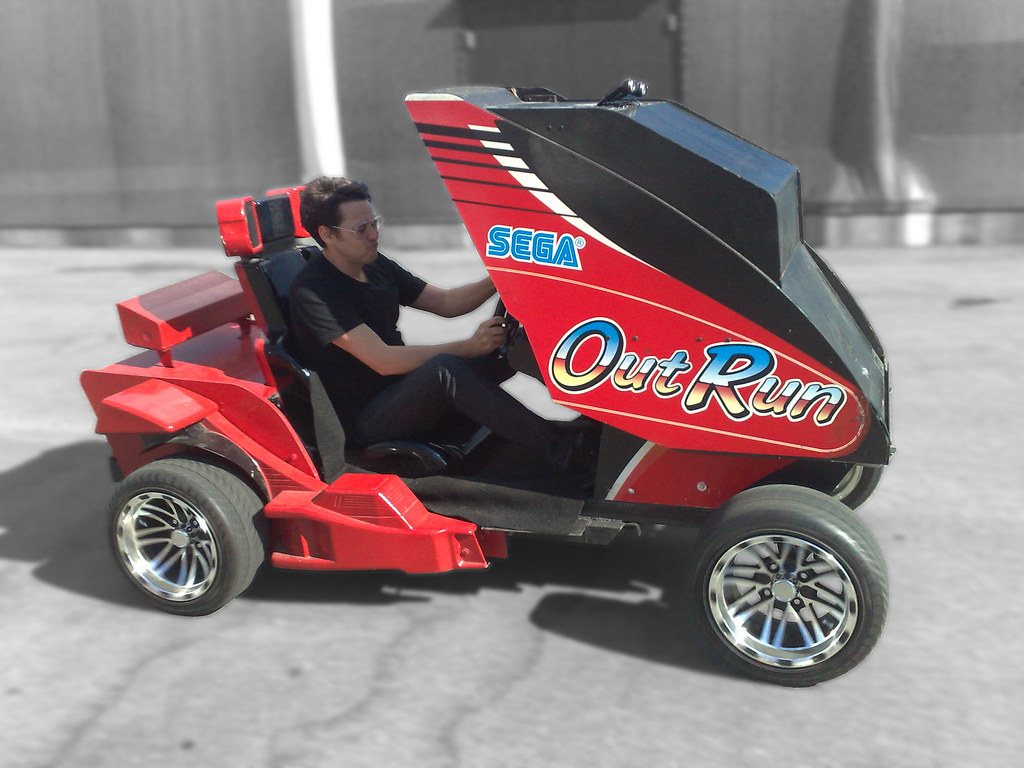
Brody Condon Test Drives OutRun at O1SJ, September 2010
Overview
Garnet Hertz's video game concept car combines a car-shaped arcade
game cabinet with a real world electric vehicle to produce a video
game system that actually drives. OutRun offers a unique mixed
reality simulation as one physically drives through an 8-bit video
game. The windshield of the system features custom software that
transforms the real world into an 8-bit video game, enabling the user
to have limitless gameplay opportunities while driving. Hertz has
designed OutRun to de-simulate the driving component of a video game:
where game simulations strive to be increasingly realistic (usually
focused on graphics), this system pursues "real" driving through the
game. Additionally, playing off the game-like experience one can have
driving with an automobile navigation system, OutRun explores the
consequences of using only a computer model of the world as a
navigation tool for driving.
Project Description
The OutRun project is a game and media art project that explores the overlap between the physical world and game environments. OutRun explores the act of driving a vehicle and the interstitial space between everyday life (driving an automobile) and a simulation of it (playing a driving video game) by combining the real world and OutRun, an 8-bit arcade driving game released by Sega in 1986. This project features two main components:
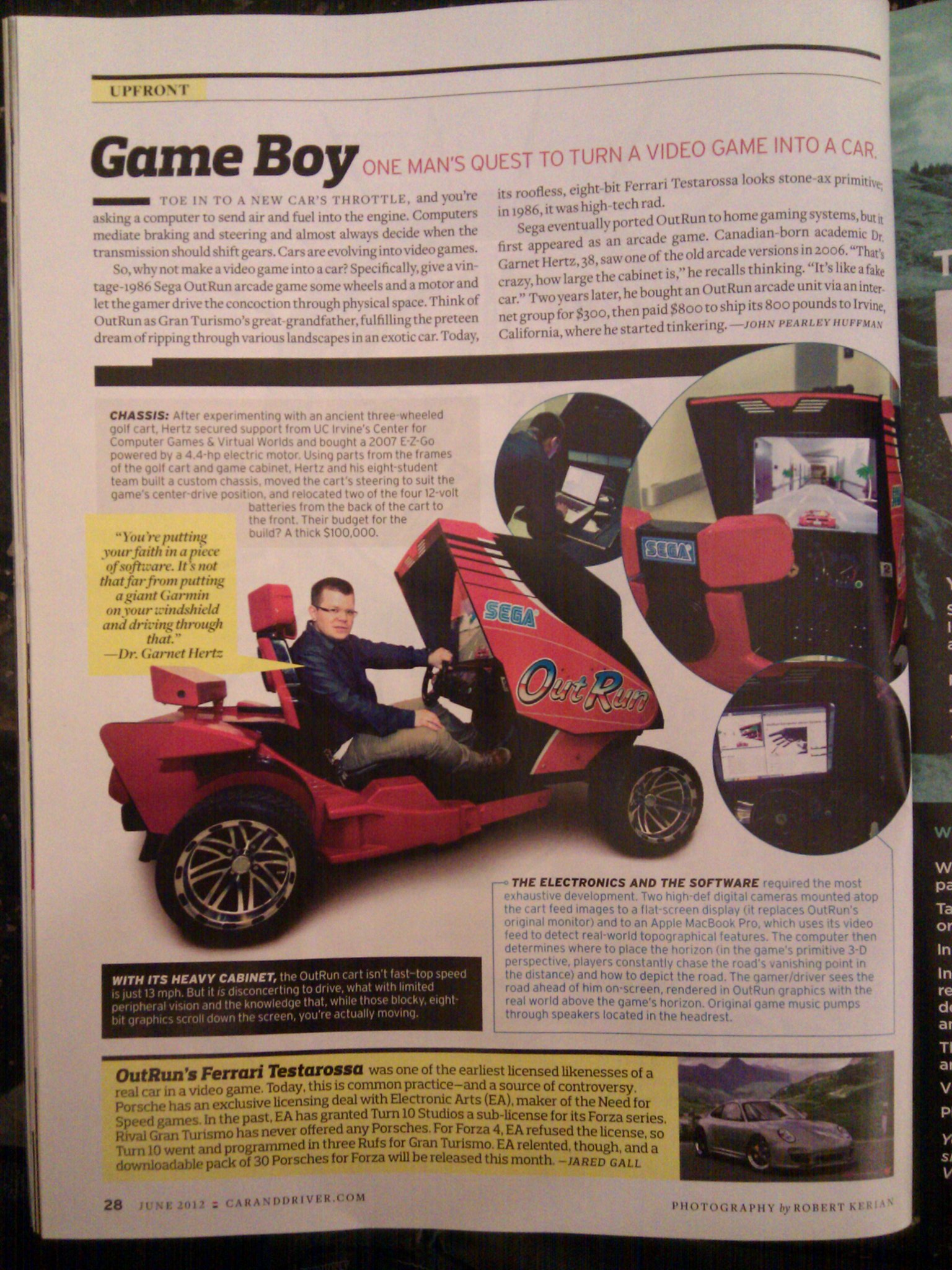
Cabinet-Car: A car-shaped sit-down arcade cabinet from Sega's OutRun is converted into a small car that can actually drive. This is done by modifying an existing fiberglass and wood cabinet to include motors, wheels and drivetrain components from an electric golf cart. This customized cabinet-car uses the existing videogame controls (steering wheel, acceleration pedal, brake pedal) to control the vehicle to a maximum speed of 20 kilometers (13 miles) per hour. See Figure 1 for a mockup diagram of the completed cabinet-car.
Custom Augmented Reality Software: The screen, which is positioned in front of the driver, renders the real world in the style of the 1986 video game OutRun by Sega. This is done through custom-built software to display a street-level view rendered in the style of the vintage video game. In other words, the driver only sees an 8-bit-style game rendered in their "windshield," which appears as if they are playing the 1986 videogame. Accelerating or turning the car-cabinet in the real world will proportionally change the display. Although the screen will mimic the real world around it, the augmented display and the real world do not match perfectly.
Project Motivation
This project is motivated by the following concepts:
The De-Simulation of Driving - This project de-simulates the driving component of a videogame. Driving game simulations strive to be increasingly realistic, but this realism is usually focused on graphical representations. Instead, this system pursues "real" driving through a videogame as its primary goal.
GPS Navigation & Mixed Reality Seamfulness - Driving in a real automobile with a GPS navigation system can be game-like. This project explores the consequences of only using a computer model of the world as a navigation tool for driving. The windshield of this project's vehicle only shows a re-rendered simulation of the immediate environment, and as a result, driving it in the real world will likely be difficult or dangerous. As a result, this project explores and investigates how augmented reality and GPS data differs from the physical world, and what happens when an augmentation of reality envelops and obfuscates reality.
A system that intentionally plays with parallax between the physical environment and mixed reality can be described as seamfulness, a concept initially proposed by Mark Weiser in 1994 and expanded since 2002 by Matthew Chalmers and other researchers at the University of Glasgow. Seamful design can be defined as an approach to reveal and exploit inevitable technical limitations in ubiquitous computing systems rather than hiding them. Seamful design starts with the assumption that infrastructures and users in the real world have limited technical resources: patchy network coverage, fluctuating signal strength for wireless networks and inaccuracies in positioning systems are the norm, not the exception. For example, seamful design argues that these seams and gaps should be exploited and used in mobile game design for more fault-tolerant usability and more engaging gameplay.
Private demo for Popular Science Magazine (February 2012)
Private demo for Discovery Channel Canada (April 2012)
Private demo for Car & Driver Magazine (June 2012)
Publications / Press
Academic Publications:
"OutRun: Perversive Games and Designing the De-Simulation of Eight-bit Driving" (FDG '10 Proceedings of the Fifth International Conference on the Foundations of Digital Games).
Abstract:
This paper outlines the development process of a mixed reality video game prototype that combines a classic arcade driving game with a real world vehicle. In this project the user, or player, maneuvers the car-shaped arcade cabinet through actual physical space using a screen as a navigational guide which renders the real world in the style of an 8-bit video game. This case study is presented as a "perversive game": an attempt to disrupt the everyday by highlighting and inverting conventional behavior through humor and paradox.
(Download the paper: OutRun: Perversive Games and Designing the De-Simulation of Eight-bit Driving (or through ACM Digital Library), 3.1MB PDF, 2010)
"OutRun: Exploring Seamful Design in the Development of an Augmented Reality Art Project" (IEEE International Symposium on Mixed and Augmented Reality 2010). Co-authored with Jong Weon Lee and Chris Guevara. Conference proceedings, ISMAR 2010, Seoul, South Korea, October 14th 2010.
Abstract: This paper outlines the development process of an augmented reality video game prototype that combines a classic arcade driving game with a real world vehicle. In this project the user, or driver, maneuvers the car-shaped arcade cabinet through actual physical space using a screen as a navigational guide which renders the real world in the style of an 8-bit video game. This case study is presented as a seamful augmented reality (AR) system: a project that exploits inevitable technical limitations of AR. We propose that the concept of seamfulness has important design implications for both AR and electronic media art projects and illustrate this through a description of the OutRun system development process.
(Download the paper: OutRun: Exploring Seamful Design in the Development of an Augmented Reality Art Project, 925K PDF, 2010)
"You drive a Ferrari Testarossa through various stages each with a checkpoint at the end of the stage that must be reached within the time limit. The player can choose which route to take through the game. The driver also has a choice of three different themes to listen to while driving."
Contributions: Thanks to Chris Guevara, Jong Weon Lee, Walt Scacchi, Jeremy Bailey, Gillian Hayes, Christina Lopes, Amelia Guimarin, Matt Wong, Erik Olson, David Dinh, Matt Shigekawa, Jessee Joseph, Mike Tang and Alex Szeto for their development efforts and assistance.
The OutRun project is directed by Garnet Hertz and has been supported by the following organizations at the University of California Irvine: the Laboratory for Ubiquitous Computing and Interaction, the Arts Computation Engineering Program, the Center for Computer Games and Virtual Worlds, the Institute for Software Research, and the California Institute for Telecommunications and Information Technology. Support for this research is also provided through grants from the National Science Foundation #0808783; Digital Industry Promotion Agency, Global Research and Development Collaboration Center, Daegu, South Korea. No endorsement implied.
Thanks: Thanks to Eric Kabisch, Adrian Herbez, Jonah Brucker-Cohen and Mark Allen for feedback on this project.