Photostereosynthesis:

Research into the archaeology the “deep” images of Lumière

Garnet Hertz  •  1 October 2007  •   garnethertz@gmail.com


Figure 1.  Image by Shardcore


Abstract:

Research and development of a custom microprocessor-based digital camera focus controller in the style of Louis Lumière’s 1920s-era layered photographic technology, Photostereosynthesis.

Keywords:

Photostererosynthesis, photostéréosynthèse, Lumière, film history, photography history, media art history, new media, media archaeology, digital imaging, 3D, photography, microcontroller, robotics, software.

Project URL:

< http://www.conceptlab.com/photostereosynthesis >

Goals & Aims of Research

    This research grant in computer integrated media focuses on the construction of a custom microcontroller-based digital SLR camera focal control system, with the intentions of re-creating "photosterosynthesis": a photo-based 3D imaging technique invented by Louis Lumière in Paris, France in the first two decades of the 1900s.  This imaging technology produces dimensionally deep and multi-layered images, and has the ability to be considerably explored and expanded with contemporary lenses, cameras, and software.

    The purpose of this project is to develop contemporary camera control software for the production of large format digital photostereosynthesis images.  At a later date, these images will be used as components in a large-scale media art installation, proposed to be exhibited at Ars Electronica in 2009.

    On a historical and theoretical level, this project also excavates a lost imaging technology developed by the co-inventor of contemporary cinema, Louis Lumière.  Historiographically, this project proposes that Lumière's primary interest in the invention of cinema was the exploration of depth, not movement.

    As an overview, this proposal:

• provides a historical context for this project

• outlines a five stage plan for the completion of this research project

• explains the technical mechanics of the proposed system

• describes the artist’s previous experience in the media arts, and how this project enriches and expands his career

• includes a detailed timeline and budget.

Detailed Description of Activity - Historical Context

    Louis and Auguste Lumière are best known as inventors of the cinematographic projector and the first publicly screened film: La Sortie de l'Usine Lumière à Lyon (1895).  Film historians widely consider the Lumière brothers to be the inventors of contemporary cinema.

Figure 2.  Lumière Brothers, La Sortie de l'Usine Lumière à Lyon, (1895).


    Through his life, Louis Lumière continued to investigate different imaging technologies, and in the early 1900s invented photostereosynthesis: a process in which a series of still photographs are shot at extremely small depths of field (wide open aperture / shallow focus) at incrementally increasing focal lengths (20cm, 22cm, 24cm, 26cm, 28cm, for example).

    Each individual exposure is printed as a transparent positive on glass and stacked to produce a composite 3D photo with the subject entombed in a translucent backlit image several centimeters thick.

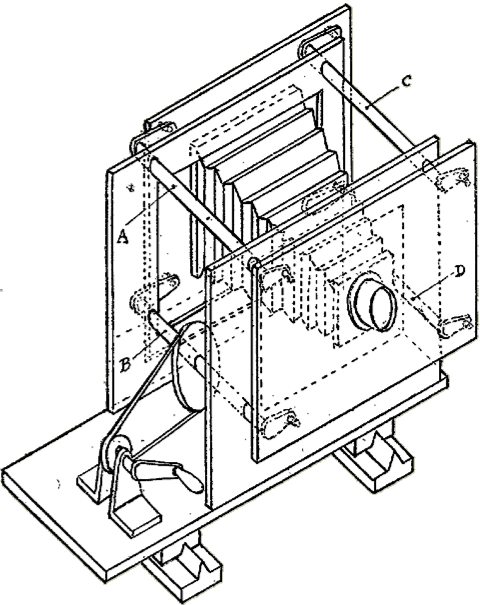
    Traditionally, this photographic technology was only used for portraiture, and used a large format camera built by Lumière that mechanically narrowed the image's depth of focus.  Images were difficult to produce and print, demanded that the model sit still for a long period of time between camera adjustments/exposures, and required a custom camera.  Although photostereosynthesis was an aesthetically beautiful imaging technology, it failed to succeeded commercially.  Only twelve examples of photostereosynthesis have survived today, and the custom camera has been destroyed.

lumiere-layers-2x4-640w.jpg

Figure 3.  Louis Lumière, Portraits of Auguste Lumière, stages in ‘photostéréosynthèse’, c. 1920

Gelatin silver prints; each print about 24 x 18cm.


photostereosynthesis-camera.jpg

Figure 4.  Photograph of the custom camera used in Photostereosynthesis, in Raymond Lecuyer, Histoire de la Photographie , Baschet et Cie, Prais, 1945, p. 289.

Detailed Description of Activity - Project Research

    Current digital SLR camera systems have the capability to overcome many of the obstacles involved in the original production of photostereosynthesis images. Fast exposure framerates, high resolution digital sensors, computerized focus control software, and extremely large aperture lenses combine to provide a camera system that could - at least in theory - shoot a photostereosynthesis series of images in under one second.  Although the imaging technology has little commercial application, its unique qualities are ideally suited for research in media arts.

    At its core, this project strives to construct custom camera control software to facilitate the production of photostereosynthesis images on a standard, unmodified 35mm digital SLR camera.  These images will be used as components of a large format media art installation.

Research Stage 1:

Camera Acquisition

    To initiate this project, a digital camera and lens needs to be rented.  The camera system needs to have: 1. Robust camera control software with a USB computer interface, 2. Rapid motor/auto focus lens with very large aperture, 3. A high-speed burst mode to shoot multiple images quickly, and 4. A high resolution digital sensor to facilitate the printing of large format images.

    The best camera for this job is the Canon EOS-1Ds Mark III body, with a Canon EF 50mm f/1.2L USM lens.  This camera system has a robust software development environment, has an f/1.2 motor focus lens, and can shoot 21.1 RAW megapixel images at five frames per second.


canon-eos1-ds-mark3.jpg

Canon EF 50mm f-12 L USM.jpg

Figure 5.  Canon EOS-1Ds Mark III body, with a Canon EF 50mm f/1.2L USM lens.

Research Stage 2:

Computer-Based Camera Control

    Canon EOS cameras have an excellent software development environment: a computer environment that helps people develop their own camera control software.   This has helped produce numerous software packages to automate camera focal control, many of which are available free of charge.

eclipse-software-screenshot-bruenjes.gif

Figure 6.  A screenshot of Eclipse, a freeware software system designed by Fred Bruenjes to design Canon EOS camera control scripts.

    To begin this project, a Canon EOS camera and lens will be rented, and existing freeware camera control software - like Eclipse - will be used to develop a laptop-based camera control system for the production of photostereosynthesis images.  This software allows users to develop scripts to control focus and shutter settings via a USB cable connected between the camera and a computer.  In the case of this project, a simple script will be developed to take photos at incremental focal lengths: 20cm, 22cm, 24cm, 26cm, and 28cm for example.

Research Stage 3:

Microcontroller-Based Camera Control

    Once a cabled laptop system is functioning, the development of a small microcontroller-based camera controller will begin.  The purpose of this system will be to not have to carry a laptop during all photo shoots.  Instead, the same camera control information can be transmitted with a small device that plugs directly into the camera’s USB port.

Parallax-PropStickUSB-32210.jpg

Figure 7.  Parallax’s PropStick USB Microcontroller. See http://www.parallax.com/detail.asp?product_id=32210

    This camera controller will be developed using Parallax's PropStick USB to send focus control data to the camera.  This microprocessor is a good choice because it is compact, easy to program, has a built-in USB interface, and is relatively inexpensive ($79.95).  In addition, I have considerable experience programming Parallax microcontrollers.

Research Stage 4:

A Simple Backup-Plan - Mechanical Focus

    If the Canon EOS focus control data is in a format that is too difficult to be transmitted by the Parallax PropStick USB, a "Plan B" method of controlling the focal length of the lens can be achieved by building a simple motor mechanism to mechanically spin the focus ring of the camera lens.  Simply put, a slowly rotating motor will be attached to the exterior of the camera lens to spin the focus ring at a slow but constant rate.  Although not as elegant as a custom-programmed USB software camera controller, a mechanical robotic controller is a good method to achieve a very similar photographic effect.

Research Stage 5:

Maquettes and Full-Scale Proposal

    Once a number of photostereosynthesis image sets are captured, the images will be printed on transparent medium and mounted on glass.  At this point, it is proposed that these prints will be 60cm x 60cm in size.

    These layered images will be used as maquettes to plan out the subject matter and physical installation of a full-scale project.  Once this investigation is complete, a production funding proposal will be submitted in Fall 2008.


    At this point, it is proposed that these images be assembled into a large glass dome, similar to Michael Maranda's Spherorama (1991). Each panel would be a multi-layered photostereosynthetic image and mounted between sheets of glass, framed in aluminum, suspended from the ceiling, and backlit. Similarly, the display structure could have four transparent concentric spheres, approximately 280cm, 300cm, 320cm and 340cm in diameter. More information on this spherical display structure can be seen at hertz-photostereosynthesis-sphere-3jan2008.pdf (690K PDF File). A proposed diagram for the structure is as follows:


    An alternative (and perhaps simpler) format of presentation could also include a 360° cylindrical panorama in the style of Lumière's "photorama" format, with the addition of multiple layers.

Importance to Development of Work

    This research is an important step in moving my career beyond the success of my previous project, “Cockroach Controlled Mobile Robot” a piece that has been exhibited at Ars Electronica, Siggraph, InterAccess, in Ireland, the Netherlands, and through the United States and Canada.  This project has received significant press internationally, has been in numerous publications and continues to be regularly exhibited.  Please visit my CV, available online at http://conceptlab.com/garnethertz for details of my previous experience in the media arts over the past 12 years.

    The research project in Photostereosynthesis is a break from using living organisms, and  represents an excavation and exploration of my original roots in studio arts.  Within Photostereosynthesis,  technological development exists primarily as a background to the production of an aesthetic gallery object.

    On a theoretical and historical level, this research revives and expands an imaging technology developed by the co-inventor of contemporary cinema, Louis Lumière.  In the process, this project highlights the important but often academically neglected perspective that Lumière's career and the invention of cinema was not only an exploration into the moving image, but primarily one of several projects in researching a “deep” image.

q

Appendix A.

Research Schedule

01 Jan 2008 - 31 May 2008    
Stages 1 & 2: Camera Acquisition & Computer-Based Camera Control

                    Preliminary research and part-time production (5 months)

                    (28% of time, 2 days/week)

01 Jun 2008 - 31 Aug 2008    
Stages 3 & 4: Microcontroller Camera Control & Mechanical Focus

                    Full-time production, software development, shooting (3 months)

                    (72% of time, 5 days/week)

01 Sep 2008 - 30 Sep 2008    
Stage 5: Maquettes and Full-Scale Proposal

                    Mock-ups and planning for larger scale project (1 month)

                    Final Grant Report & writing of detailed proposal for Creative Production Grant

                    (72% of time, 5 days/week)

Appendix B.

Research Budget (available upon request)

Appendix C.

Support Material

Support material for this project is provided online, and is viewable through any standard web browser.

Please see the URLs below:

< http://www.conceptlab.com/photostereosyntheis>

Preliminary documentation of this research project.

< http://www.conceptlab.com/change/lectures/2007-may-09-ucigsfir/ >

Lecture on Photostereosynthesis and Interdisciplinarity

< http://www.conceptlab.com/control>

Previous project, the Cockroach Controlled Mobile Robot.

< http://www.conceptlab.com >

Homepage of Garnet Hertz, featuring recent updates and archives of completed projects.

< http://www.conceptlab.com/garnethertz >

CV of Garnet Hertz